
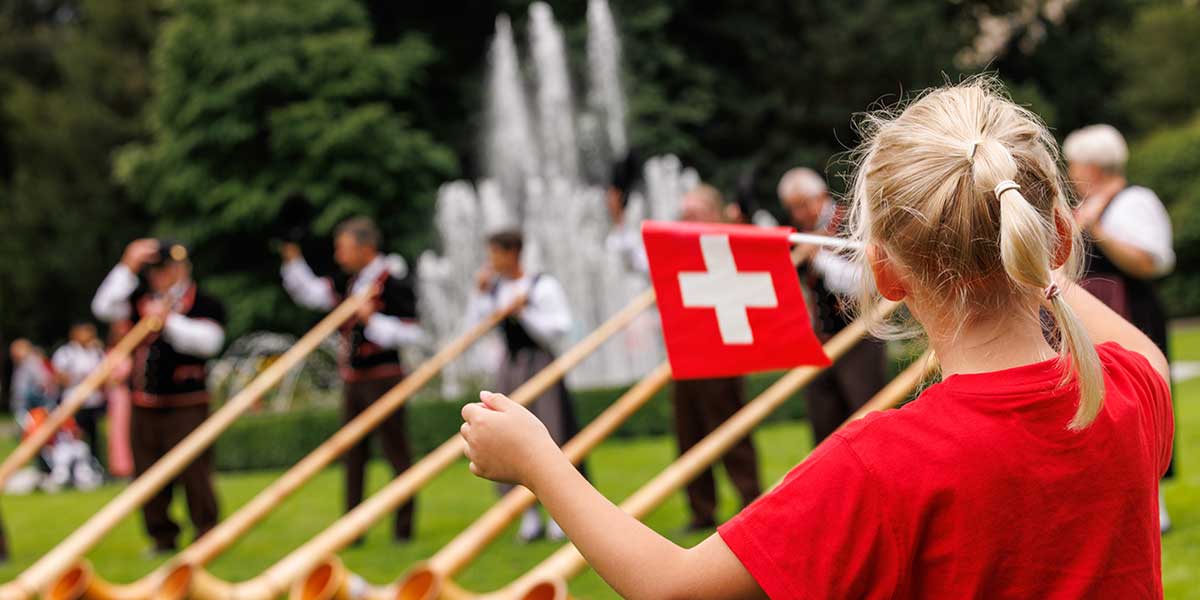
The big cities of Switzerland are beautiful, sophisticated and modern, but if what you imagine are wooden chalets, green meadows, mountain farms, cows with cowbells and the Alps dominating the horizon, Interlaken and its surroundings are much closer to that Switzerland that you have probably been wanting to see for years. Here, many of those images are not recreations for travelers, but traditions and ways of life that continue to exist.
And that is precisely what is surprising when you arrive. You can discover how one of the country's most emblematic instruments is made, listen to songs that were born among mountains, taste cheeses linked to ancient agricultural customs or meet a flock covered in flowers crossing Interlaken on the way home.
First, what exactly is an alphorn? Imagine a huge wind instrument made of wood, about 3.5 meters long, resting on the ground and with the end curved upward like a large horn. That is the alphorn, one of the symbols of the Swiss Alps and an instrument that, despite its size, has no valves or keys.
In Habkern, very close to Interlaken, you can discover how manufacturing continues. At Bernatone Alphornbau, Heinz Tschiemer and his family transform wood from the region's forests into alphorns following a traditional craft that is still alive.
In the workshop you can learn about the process from the trunk to the finished instrument, visit a small museum and even try to get a grade. That's when it becomes quite clear that making it sound good is much more difficult than it seems.
And yes, what you hear is yodeling. Maybe you don't know the word, but you probably recognize the sound. Yodeling is a traditional form of singing in which the voice quickly changes between low and high registers, creating those unique calls that immediately transport you to the Alps.
And if when you imagine it your mind goes straight to Heidi, the girl from the mountains, you are on the right track. Green meadows, cows with cowbells, immense mountains and alpine voices in the distance; All that's left is for Heidi to appear running down the slope.
But yodeling comes from long before cartoons. Vocal calls were part of life in alpine communities, where the voice could travel across large open spaces; Over time they evolved to also become songs and a cultural expression transmitted from generation to generation.
Cheese has a story before it reaches your table. During the warm months, cattle move up to alpine pastures and milk is transformed into cheese on mountain farms and cheese factories. Behind something as everyday as a wheel of cheese there is an agricultural calendar that for generations has marked the life of these communities.
One of the best examples is in the Justistal Valley, near Lake Thun. The Chästeilet is celebrated there, a tradition that dates back to 1739 and marks the end of the Alpine season, when the cheese produced during the summer is distributed among farmers according to the amount of milk provided by their cows.
That's what makes it so special. It is not a show created for visitors, but a tradition that still connects the producers, the animals, the mountains and the cheese that finally reaches the table.
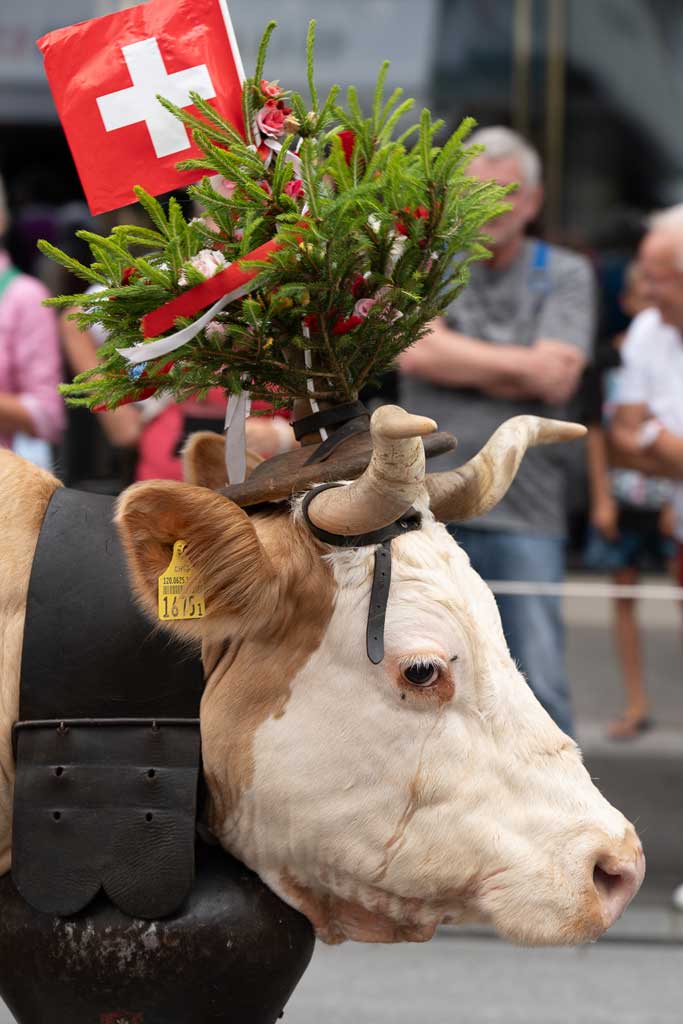 The cows are decorated on their return to the valley.
And then the cows come home. Another of those scenes that seem too Swiss to be real is the Alpabzug, the descent of the cattle after spending the warm months in the high altitude pastures. To return to the valley, many of the cows are decorated with flowers and large cowbells and descend accompanied by the farmers.
And you don't always have to go into the mountains to see it. These tours can also go through Interlaken, so first you hear the cowbells in the distance and suddenly you see a herd covered in flowers appear passing through the streets.
In Brienz, even the wood tells a story
Swiss traditions are not only heard or tasted; some are also carved by hand. In Brienz, on the shores of the lake of the same name, wood carving has been part of the local identity for generations and continues to be one of the most important traditional crafts in the region.
Here is the Wood Carving School, the only institution in Switzerland that offers professional training in this trade. In local workshops you can still see how wood is transformed into figures and objects full of detail using knowledge passed down for generations.