
Since Georges-Édouard Piaget founded the Maison in 1874—deep within the Swiss Jura Mountains—based on the founding principle of "always do better than necessary," Piaget has cultivated ultra-thin watchmaking as both a technical discipline and an artistic vocation.
This pursuit has yielded some of the thinnest movements ever created and established Piaget as one of the few Maisons to master the languages of both Fine Watchmaking and High Jewelry equally.
The 1290P caliber was conceived, developed, finished, and assembled entirely at the Piaget Manufacture in La Côte-aux-Fées, the very place where Georges-Édouard Piaget founded the Maison in 1874. Its 430 components require many weeks of manual finishing and assembly work. The bridges are hand-beveled, the mainplate features a subtle guilloché pattern, and the minute repeater hammers are hand-polished to a mirror finish.
The dial itself exemplifies Piaget’s dual mastery of Fine Watchmaking and High Jewelry. Crafted from gold, its surface displays a hand-executed guilloché pattern—a technique as demanding as any employed at the Manufacture. The result is a soleillé (sunburst) finish radiating across the surface, while a delicate opaline outer track adds contrast and depth.
A meticulously crafted gold fillet runs across the dial; its profile transitions from straight to curved, revealing glimpses of the repeater mechanism beneath. At the four o'clock position, a smoky blue sapphire ring—bearing the inscription "La Côte-aux-Fées"—sits atop the inertia governor, the specific regulator for the minute repeater mechanism that remains fully visible. Developing the dial alone required over 150 hours, with an additional 50 hours dedicated to the hand-finishing of each individual component.
The 1290P caliber delivers an intensity of 64 decibels, three harmonic overtones, and a decay factor of 2,600—all the result of exhaustive parallel research into both the movement's mechanics and the case's resonance. The hours chime in G-sharp and the minutes in A-sharp, both in the fifth octave.
All of this is housed in an 18K white gold case measuring 48 mm in diameter and just 9.30 mm thick, maintaining the fluid "shape-within-a-shape" design of the Piaget Polo. It comes with a textured blue calfskin strap featuring a folding clasp, as well as an additional leather strap.
Only five numbered examples of the Piaget Polo Minute Repeater will be produced this year. This is not a limited edition by design, but rather a consequence of the labor-intensive nature of crafting each piece.
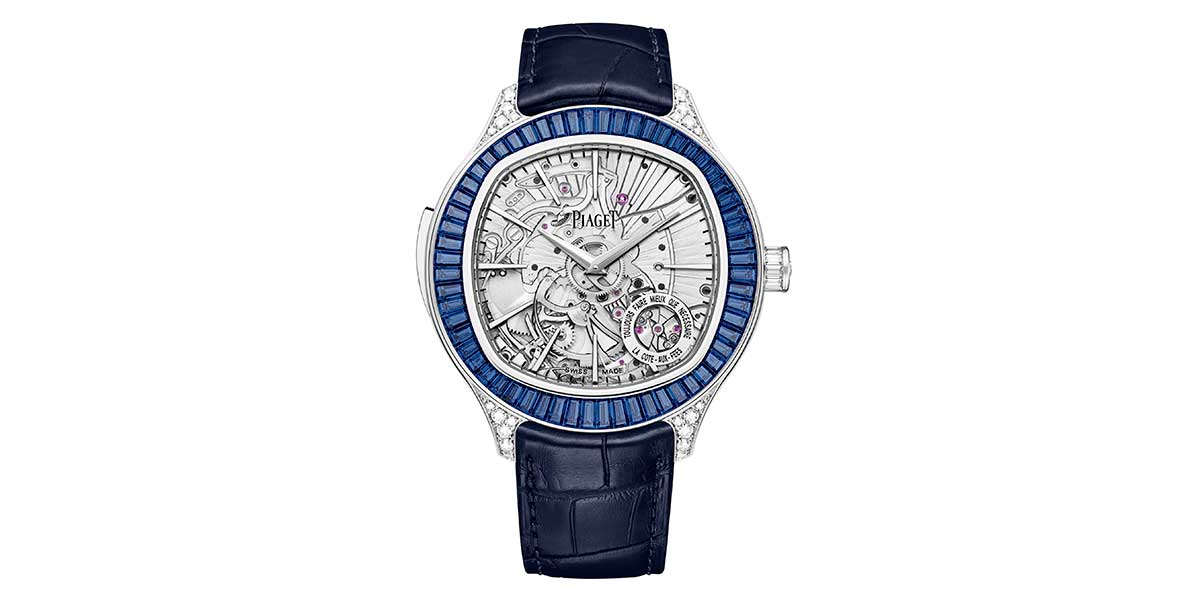
Alongside the Piaget Polo Minute Repeater, Piaget is also unveiling a High Jewellery version that fully showcases the Maison’s dual mastery of watchmaking and jewelry. The bezel is set with baguette-cut blue sapphires, while the case features a combination of baguette-cut and brilliant-cut diamonds. The dial is fully openworked, offering an unobstructed view of the more than 70 hours of craftsmanship involved.