
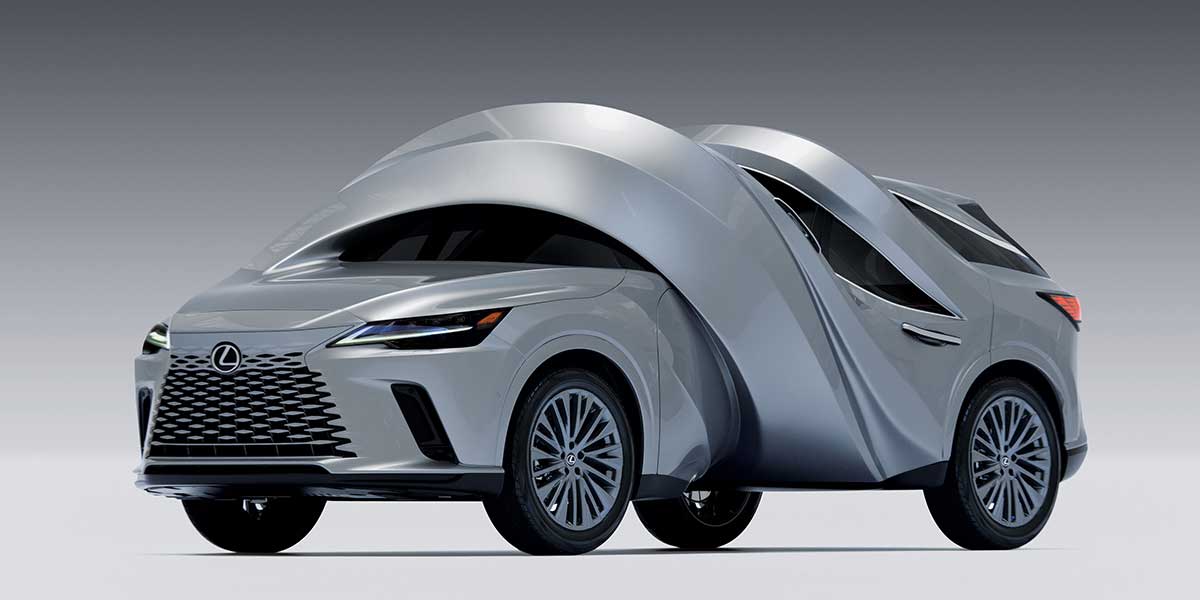
During Armory Week in New York, Motomorphosis was exhibited—a creation by the conceptual art collective MSCHF, commissioned by Lexus, which requested two new works for the show. The pieces take two production Lexus electric vehicles and reimagine them as their own sculptural doubles.
These formal distortions are a recurring motif in MSCHF’s work, which often translates the language of digital transformations into the physical world, creating a sense of impossibility. In Motomorphosis, these transformations evoke the geometric plasticity of 3D animation, where forms need not be static or fixed but instead deform and stretch via transitional frames depending on the action.
Motomorphosis displays two production cars alongside their surreal sculptural counterparts. A Lexus RZ 450e appears once as an electric vehicle and again as a sculpture in Circle Car, rotating endlessly end-over-end. Similarly, the Lexus RX 450h+ appears twice: first in its standard form and then in Twisted Car [opening photo], featuring a dramatic longitudinal twist, with its fluid lines and surface features stretched tangentially along the body's spiraling torsion.
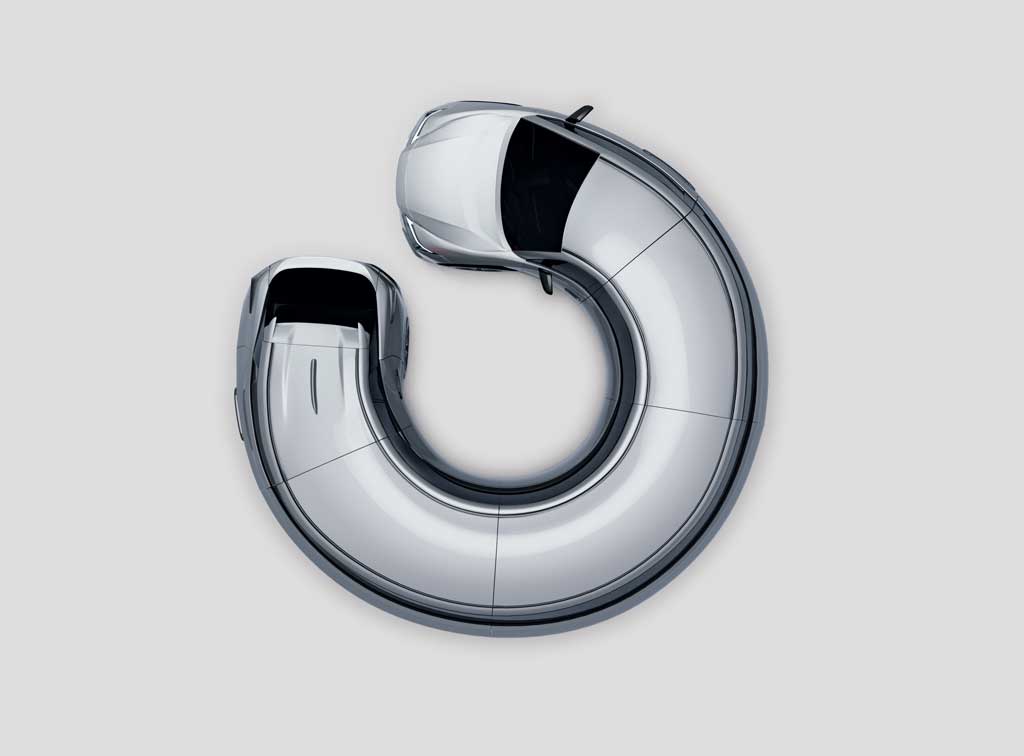 Circle Car, from the Motomorphosis series, represents an artistic rendering of a Lexus RZ 450e.
MSCHF describes these works as "formal cars"—as opposed to "concept cars"—but this also proves to be a clever inversion: while a car is designed specifically to move, the Motomorphosis works are sculpted to evoke the idea of movement. When juxtaposed with their originals—Lexus electric vehicles—Twisted Car and Circle Car reflect the fluid nature of how our minds represent objects, a process never divorced from our understanding of the automobile's dynamic capacity for movement.
For Lisa McQueen, Senior Marketing Manager at Lexus, “most conversations about electrification focus on how a vehicle is powered. Motomorphosis poses a different question: what can electricity drive in our imaginations? Collaborating with MSCHF allowed us to take the automobile beyond its usual form and explore movement, transformation, and possibilities in a whole new way.”