
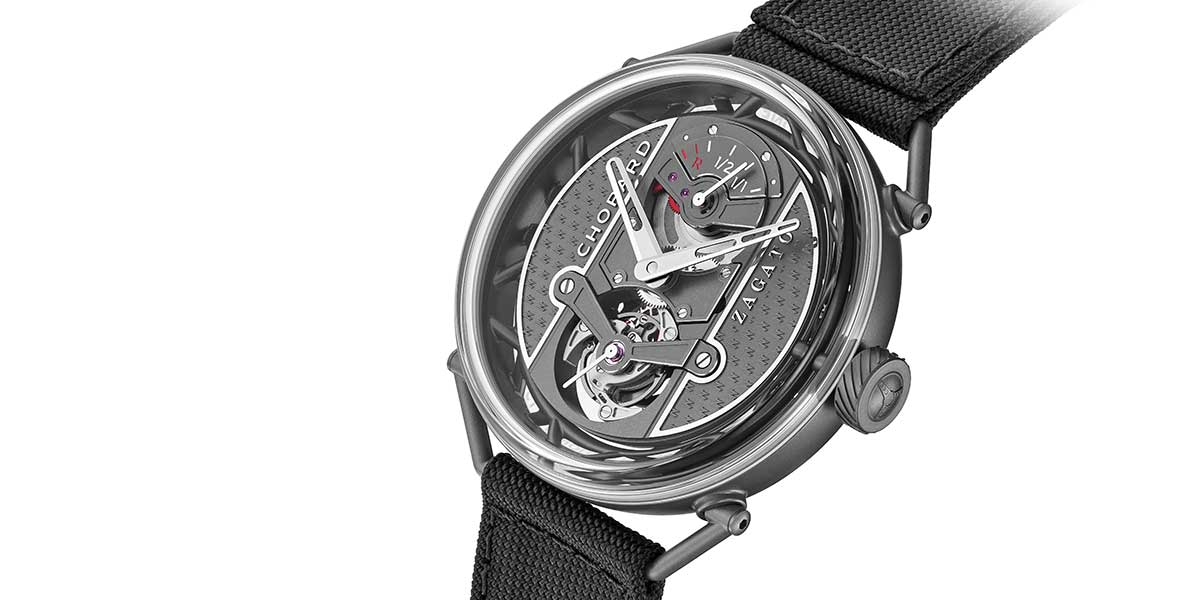
The new creative collaboration between Karl-Friedrich Scheufele (co-president of Chopard), the Chopard design team and Norihiko Harada (chief designer of Zagato) unites the emblematic codes of the two maisons to present an authentic concept-watch, a showcase of the horological prowess of the workshops of the Manufacture founded in Fleurier in 1996 and the avant-garde spirit of the Italian coachbuilder.
It magnifies the tubular architecture characteristic of automotive chassis developed by the famous body manufacturer. The movement is based on a network of tubes, a principle used in racing cars to optimize rigidity while reducing weight. This design distributes mechanical stresses in the event of impact and improves structural safety. Only 19 copies will be produced.
The free lugs, with a tubular design, allow an optimal fit of the watch to the wrist. Instead of being fixed, they adopt a rotating functionality whose amplitude is controlled by an adjustment system (approximately 45° on each side). On the side, the crown is inspired by the gears in automobile differentials and is personalized with an engraved steering wheel, which has become an iconic symbol of Chopard's Classic Racing codes.
The time indication is the subject of an aesthetic search that combines contemporaneity and legibility: the movement plate, which functions as a dial, is decorated with a repetition of Zagato's emblematic "Z" motif, and bezels enhanced by a rhodium-plated treatment. The Chopard and Zagato logos, also rhodium-plated, appear in positive relief.
The whole is crowned by a glass case fitted to the edge of the case, which improves the legibility of the dial. For the sake of symmetry, the caseback crystal adopts a similar principle to extend the case and offer a complete view of the movement, highlighting every mechanical detail.
The case, 42 mm in diameter, as well as the bridges and the movement plate, are made of ceramized titanium. This ultra-resistant metal is obtained through a titanium oxidation process using electroplasma technology, a treatment that gives it a hardness of 1,000 Vickers and resistance to impacts and scratches comparable to that of ceramics.
Thanks to its lightness, it allows workshops to offer this watch with a total weight of only 43.20 grams, including the strap. Ceramized titanium, a material developed for the aerospace and automotive industries, has an anthracite gray color that does not wear over time, a highly appreciated feature in a watch designed for the most extreme conditions.
The L.U.C caliber 04.04-L: a light and efficient watch engine
While the watch's aesthetic evokes the aerodynamic lines of Zagato concept cars, its horological engine embodies the same pursuit of performance, particularly through the use of ceramized titanium. Like the watch case, the bridges and the caliber plate are made with this latest generation material, whose lightness and resistance reinforce the technical identity of the piece.
From the first conversations about this project, one thing was clear: this model would incorporate an evolution of Chopard Manufacture's Engine One Tourbillon caliber, which in 2010 introduced a true aesthetic hybrid between automotive mechanics and fine watchmaking. This new mechanical racing car retains the characteristic fuel gauge of its predecessor to show the power reserve, which accentuates the analogy between a dashboard and a watch face.