
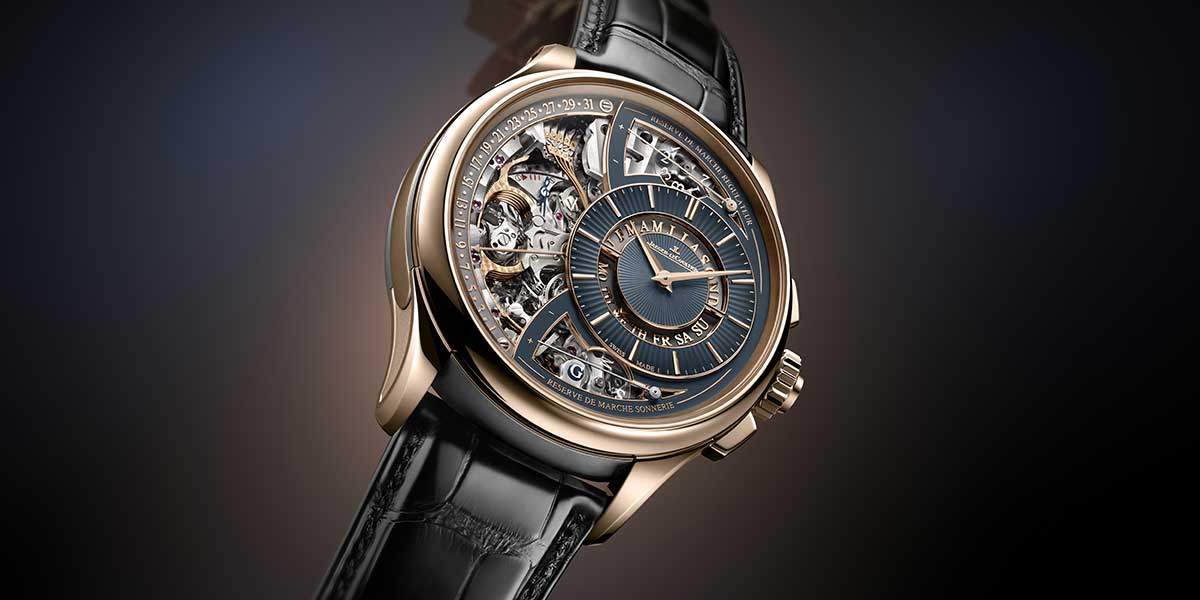
La evolución de los relojes con sonería fue llevada al extremo por Jaeger-LeCoultre con Duometre Grande Complication A Grande Sonnerie, una nueva interpretación del Calibre 182, la primera Gran Complicación con sonería de la maison para la muñeca.
Unveiled in 2009 within the Hybris Mechanica à Grande Sonnerie, Calibre 182 marked a milestone in watchmaking. By incorporating a Grande Sonnerie with Westminster-style chimes—the most exclusive chiming mechanism—along with a Petite Sonnerie, a minute repeater, a retrograde perpetual calendar, a flying tourbillon, and two power reserve indicators, it was not only one of the most complicated wristwatches ever made at the time, but it also utilized the innovative Duometre system (invented by Jaeger-LeCoultre in 2007) to manage the calibre's extreme energy demands. Only a single model was produced.
Due to the extreme complexity of Calibre 182, very few examples were made; comprising some 1,300 parts, the movement takes a full year just to assemble and regulate, a process involving four phases and a total of 16,000 different operations: assembly, disassembly, corrections and cleaning, and final assembly.
Now, thanks to significant technical advancements focused on enhancing acoustic chime quality and movement robustness, Jaeger-LeCoultre presents a new interpretation of Calibre 182. This fully integrated movement, protected by eight patents (six of which are specific to Calibre 182), incorporates 15 complications. The watch features a ninth patent covering the micro-adjustment mechanism on the alligator leather strap's buckle. Three ways to chime: Equipped with four gongs and four hammers—as opposed to the two gongs typically found in minute repeaters and most striking movements—Calibre 182 can produce four distinct notes (in various combinations) in the style of the Westminster chimes, the famous melody of London’s Big Ben.
616 notes, 7.5 hours: The four notes of Calibre 182—E, C, D, G (E-C-D-G), each corresponding to one of the four gongs—are played in five phrases consisting of different permutations. These are combined in various ways to create a unique melody for each quarter-hour. The melody for the first quarter-hour comprises four notes (one phrase); the second, eight notes (two four-note phrases); and the third, twelve notes (three four-note phrases).
The main dial and the calendar, hour, and minute display are finished in a dark, blue-grey lacquer, providing a subtle visual contrast to the intricate moving parts and the rose gold elements—the latter appearing on various components, most notably the five racks and their corresponding springs, visible between 10 and 11 o’clock.
The center of the hour and minute dial features a sunburst-brushed finish beneath the lacquer, while the outer ring—finished in a dark blue gradient lacquer over a sunburst-patterned guilloché —serves as a backdrop for the applied 18-karat (750/1000) rose gold hour markers.
Reflecting the complexity of the movement, the Grande Tradition case is composed of 60 individual parts, combining a titanium body with 18-karat (750/1000) rose gold elements, including the lugs, bezel, and push-pieces. The rose gold components feature a combination of micro-blasted and polished finishes. The Duometre Grande Complication à Grande Sonnerie is housed in a 45 mm case—a feat of miniaturization for a movement comprising 1,300 parts—complemented by a black alligator leather strap. It includes the folding buckle characteristic of the Hybris series, which incorporates a patented mechanism for precise adjustment and a perfect fit on the wrist.