
Gustav Klimt (1862-1918) began his artistic career far from the dazzling portraits for which he is known today.
Trained at the Kunstgewerbeschule in Vienna, a school of applied arts and crafts, he worked as an architectural painter, creating murals and frescoes for the ceilings of public buildings. His early works were traditional and of high quality; it was later that he developed his radical and ornamental style.
In 1897, Klimt and a group of like-minded artists broke away from the conservative Künstlerhaus to form the Vienna Secession. Their aim was to create a space for modern and international art in Austria, art that prioritized innovation over tradition. Klimt was elected the group's first president and played a pivotal role in launching its influential journal, Ver Sacrum. The Secession's motto, "To every age its art, to every art its freedom," remains relevant today.
Klimt lived most of his life in and around Vienna, but some key trips had a lasting impact. A trip to Venice and Ravenna in 1903 proved particularly significant. The golden mosaics of San Vitale and other Byzantine churches profoundly influenced his use of gold and flat space. This fusion of sacred art with sensual themes became one of his defining characteristics.
Klimt's best-known works—including The Kiss (1907-1908) and Portrait of Adele Bloch-Bauer I (1907)—belong to what is now known as his "Golden Phase."
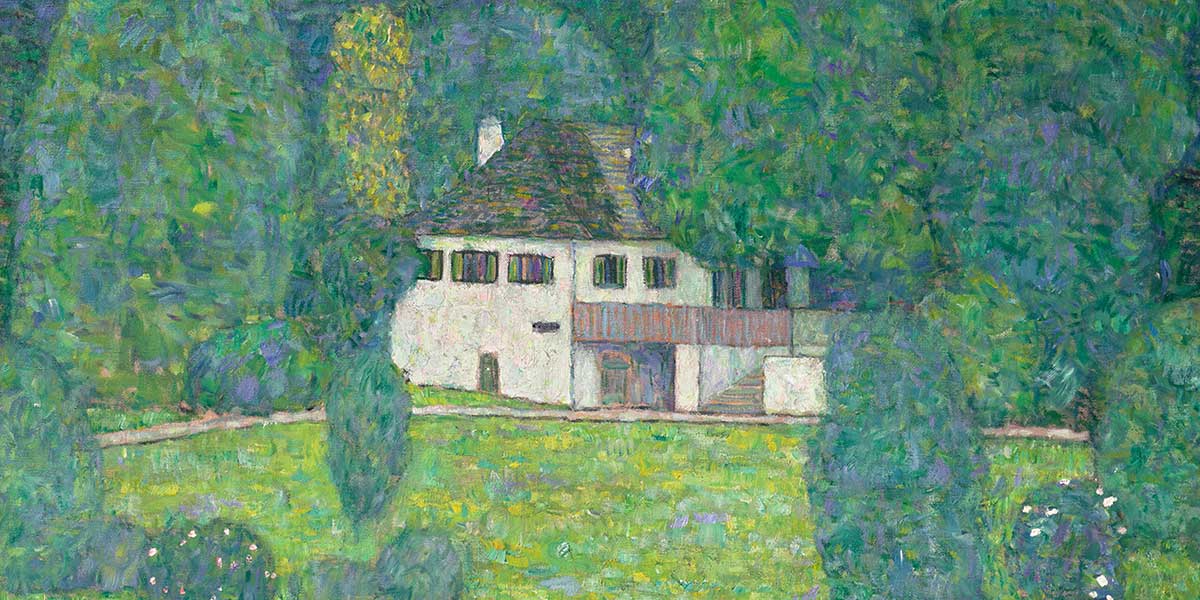
Klimt portrayed many of the most prominent women in late 19th-century Vienna. Often, these were not only members of high society but also intellectuals, patrons, and artists in their own right, such as Adele Bloch-Bauer, Serena Lederer, and Eugenia Primavesi (the original owner of the Litzlbergkeller, 1915-1916, currently on offer).
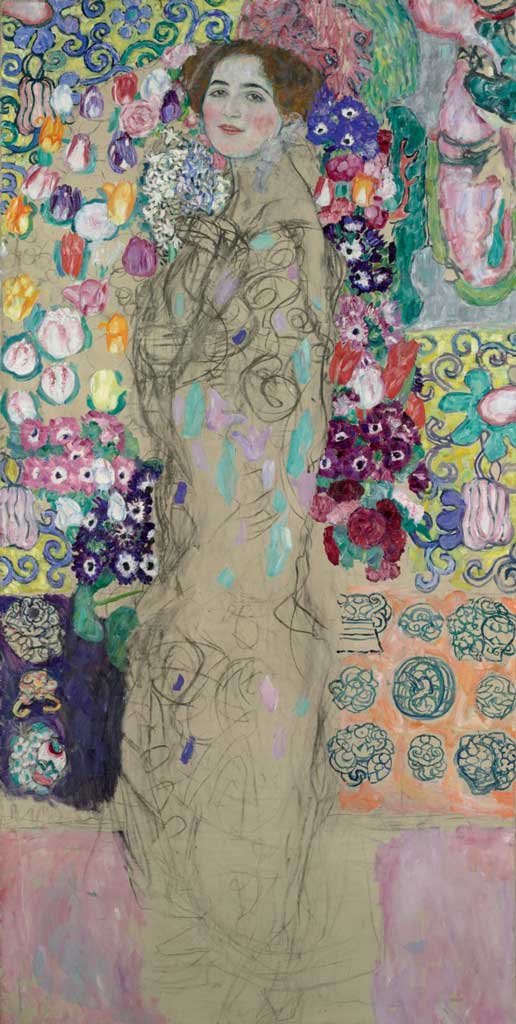 Gustav Klimt, Frauenbildnis (Portrait of Ria Munk III), 1917-18. Oil and charcoal on canvas. 180.7 × 89.9 cm. Sold for £18,801,250 on June 23, 2010, at Christie's, London.
Klimt's landscapes, painted mainly during his summer holidays at Attersee, a lake in Upper Austria, represent a quieter, more contemplative side of his work. Devoid of figures, these landscapes focus on trees, lakes, and gardens, rendered with pointillist precision and meticulous perspective.
Klimt's decorative vision transcended painting. For the Stoclet Palace in Brussels, he created dazzling mosaic panels—Expectation, The Tree of Life, and Fulfillment (1905–1911)—combining gold, patterns, and symbolism in what he called “the final stage of my ornamental development.”
Not all of Klimt’s work was met with admiration. In 1900, he was commissioned to paint three panels for the ceiling of the University of Vienna: Philosophy, Medicine, and Jurisprudence. The works, filled with contorted, nude bodies and dark symbolism, were harshly criticized as indecent and incomprehensible. The controversy was so intense that Klimt returned the commission and refused to accept any further public projects. The paintings were destroyed in a fire in 1945, although photographs and sketches survive.
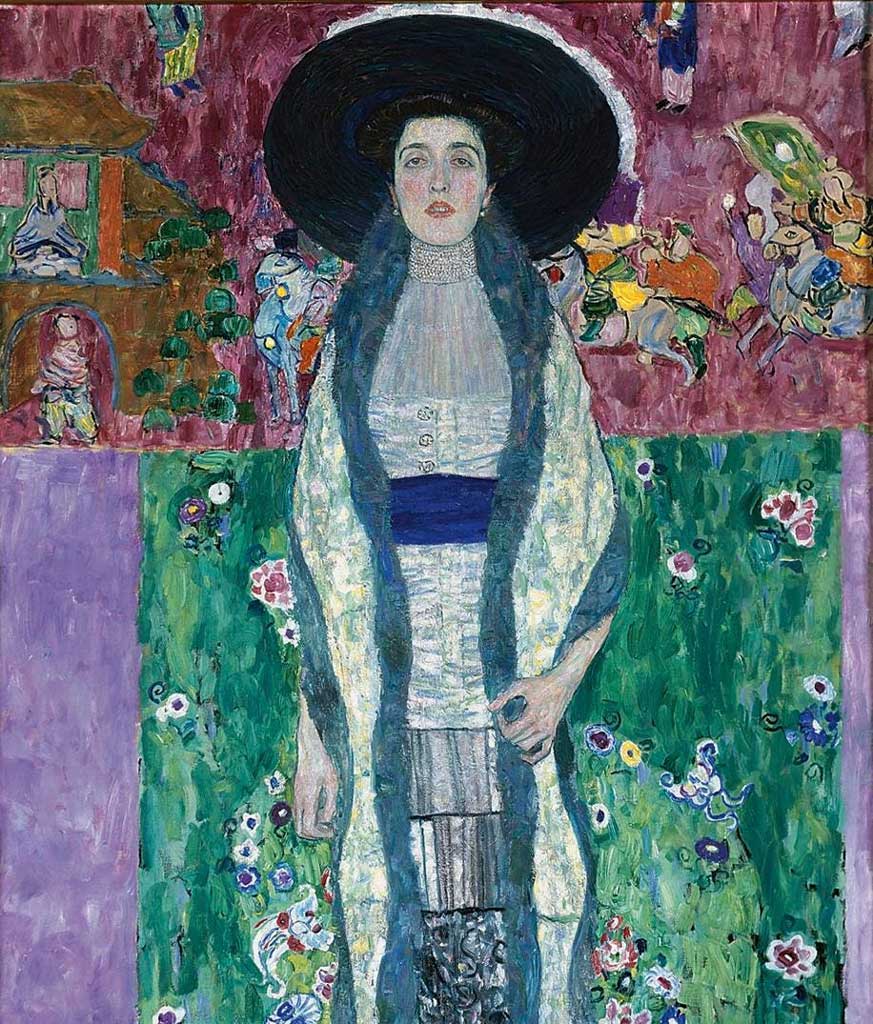 From the collection of Adele and Ferdinand Bloch-Bauer. Gustav Klimt, Portrait of Adele Bloch-Bauer II, 1912-13.
During the Nazi era, many of Klimt's paintings were confiscated from Jewish collectors. The most famous case was that of Portrait of Adele Bloch-Bauer I, which was taken from the Bloch-Bauer family and later exhibited in the Austrian State Gallery. After a long legal battle, the painting was returned to Adele's niece, Maria Altmann, in 2006. It was subsequently sold for $135 million—the highest price ever paid for a painting up to that time—at an auction brokered by Christie's, and is now on display at the Neue Galerie in New York. The case, and its dramatization in the film Woman in Gold, brought the issue of restitution to worldwide attention.
Klimt died in 1918 at the age of 55, after suffering a stroke and contracting pneumonia.
During the influenza pandemic, he was working on several unfinished paintings in a looser, more expressive style. His influence lasted long after his death: he mentored young Expressionists such as Egon Schiele and Oskar Kokoschka and remained a key figure for both Symbolism and Art Nouveau.