
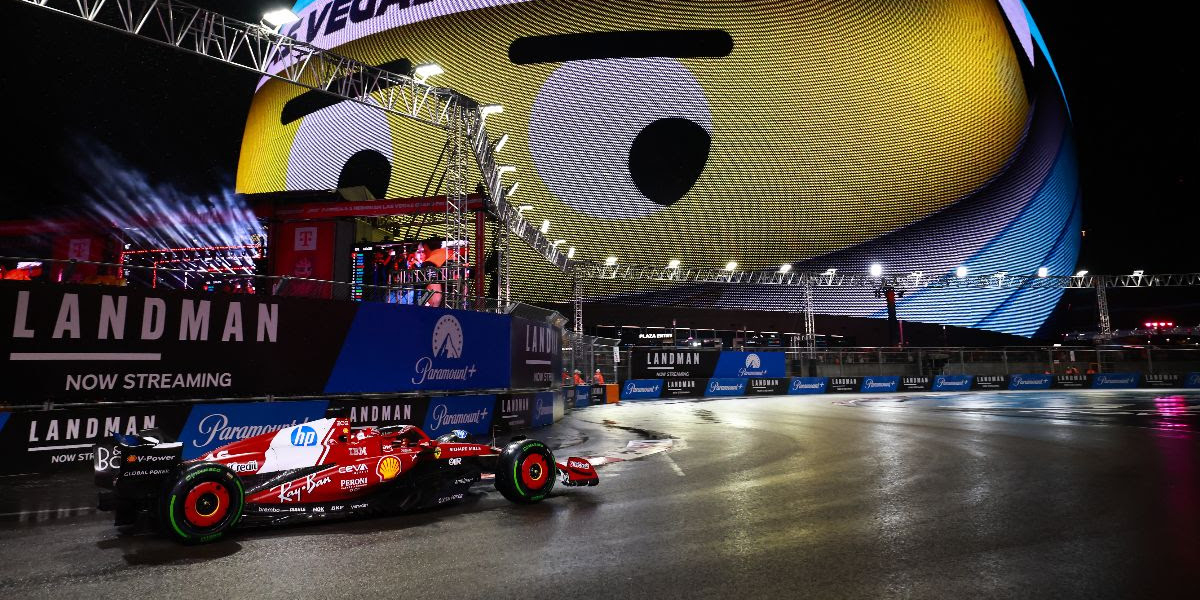
The 2026 Formula 1 World Championship season is entering its final stretch with a series of Grands Prix that share a common feature: spectacular illuminated circuits.
Las Vegas kicks off the night race tour from November 19-21, before heading to Qatar and Abu Dhabi to close out the calendar.
These three iconic venues for night racing are joined by Singapore, Bahrain, and Saudi Arabia, as the rounds with artificial lighting on the F1 calendar.
Night GPs present unique conditions that pose a challenge for both drivers and teams. Furthermore, racing under powerful floodlights allows drivers to discover a different side of the circuits, which acquire a unique visual identity after nightfall.
- Las Vegas: Speed on the Strip. The Las Vegas GP will be the next stop on the calendar, from November 19-21. Its urban layout runs through some of the city's most recognizable avenues and areas, including the round Sphere building and the avenue known as The Strip, home to its iconic hotels, casinos, and various tourist attractions. The Las Vegas Strip Circuit is 6.201 km long and consists of 50 laps.
One of the main characteristics of this GP is the combination of long straights and heavy braking zones. The circuit allows for high speeds, with averages comparable to those of Monza or the straight at the Autódromo Hermanos Rodríguez, home of the Mexican GP, and offers overtaking opportunities, especially at the end of the straights. More than 1,750 temporary lights are part of the lighting system that illuminates the track.
- Qatar: a challenge under the spotlight. The Qatar GP will be held from November 27 to 29 at the Lusail International Circuit, located just outside Doha. At 5.419 km, with 16 corners and 57 laps, Lusail is characterized by a fast and flowing layout, with a predominance of medium- and high-speed corners. Its main straight is over 1 km long and offers one of the best opportunities for overtaking.
- Abu Dhabi: the sunset that turns into night. The Abu Dhabi Grand Prix will take place from December 4 to 6 at the Yas Marina Circuit, the venue for the final race of the 2026 season. Unlike other night races, it has a unique feature: the race starts in daylight and finishes under artificial lighting. The changing light during the 58 laps makes the sunset part of the spectacle and distinguishes this race on the calendar.
The circuit is 5.281 km long and has 16 corners. Its layout encircles the Yas Island marina and passes by the Yas Hotel, whose illuminated structure has become one of the most recognizable images of the Grand Prix. Among its most important features is a 1.2 km straight, which connects two braking zones and offers overtaking opportunities.
- Singapore: the pioneer of night racing. The Singapore GP deserves special mention, as it became the first F1 night race in 2008. The Marina Bay Street Circuit is 4.927 km long and has 19 corners. Its layout winds through the streets of downtown Singapore, with the buildings of the financial district and the bay as part of the scenery.
The race represents one of the greatest physical challenges for drivers all year. The city's characteristic humidity, the temperatures inside the cockpit, and the succession of corners and braking zones require a high level of concentration throughout the 62 laps. Drivers can lose up to three kg of body weight during the race.